

Replicable, Repeatable, or Scalable?
How Founders Become the Bottleneck — and What to Do About It
Many businesses reach a stage where things are working.
Revenue is coming in.
Clients value the service.
The founder has built something real.
And yet something feels stuck.
Growth feels heavier than it should.
Every decision still comes back to you.
The business cannot move without your involvement.
At that moment the challenge is rarely the market, the product, or even the strategy.
More often, the real constraint is the way the business is structured around the founder.
The question is no longer:
How do I grow the business?
The real question becomes:
Who do I need to become for this business to grow?
When the Founder Becomes the Bottleneck
In the early days of a company, doing everything is natural.
You sell.
You deliver the work.
You maintain quality.
You manage relationships.
You make every decision.
That level of involvement is what allows a business to get off the ground.
But as the company grows, the same behaviour that created success can begin to limit it.
The founder becomes:
the decision hub
the quality controller
the person every client relationship runs through
the operational centre of the organisation
At that point growth is no longer limited by the market.
It is limited by how much the founder can personally carry.
The business needs to evolve.
And that means the founder’s role must evolve as well.
Replicable, Repeatable, or Scalable?
One of the most useful ways to think about business growth is to ask a simple question:
Is the business you are building replicable, repeatable, or scalable?
These terms are often used interchangeably, but they describe very different kinds of businesses.
Understanding the difference helps founders choose the right growth strategy.
A Career Example: How Business Models Evolve
Earlier in my career I worked in telecom software during the 1980s and 1990s.
I initially delivered systems connected to IBM environments before later working with companies such as Enator, the original builders of The Ark building in Hammersmith.
At the time most software projects were essentially replicable consulting work.
The product existed.
But every organisation required a different implementation.
Infrastructure differed.
Operating processes differed.
The system needed adapting to each client.
Over time something changed.
Instead of reinventing solutions each time, our teams began to reuse libraries of code and structured implementation methods.
The work moved from bespoke consulting toward repeatable delivery.
Later, while working at Genesys — which acquired parts of IBM’s call-centre technology business — the model evolved again.
Software could now be installed and configured by customers themselves.
At that point the business model changed fundamentally.
Revenue came less from project teams and more from software licensing.
The business had become scalable.
That same transition — from expertise, to systems, to products — is the journey many modern service businesses face today.
The Three Types of Business Growth
Replicable Businesses
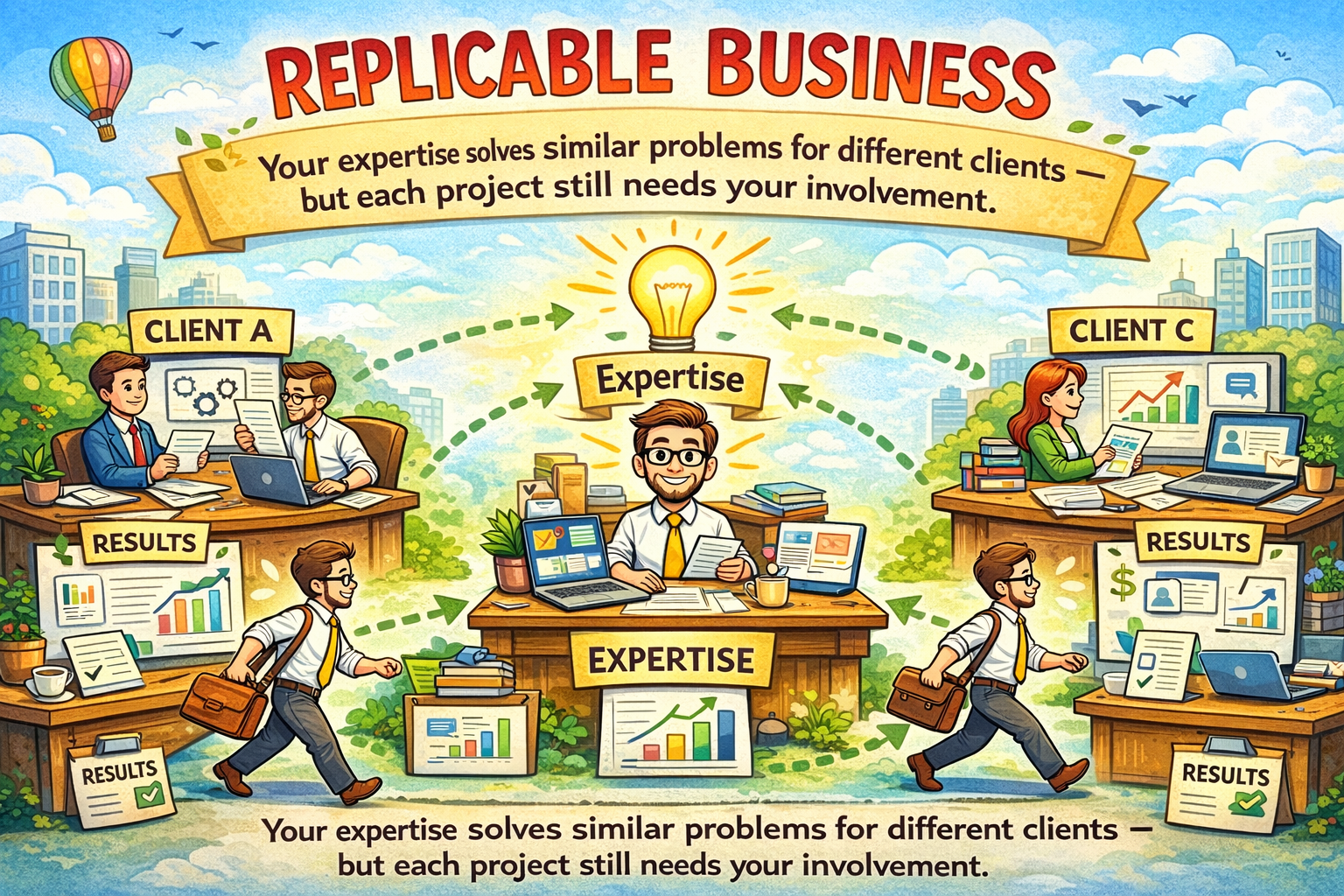
A replicable business can be reproduced elsewhere, but it still depends heavily on people — often the founder.
Each client engagement may be slightly different.
The work relies on experience, judgement, and expertise.
Typical examples include:
executive coaching
specialist consulting
organisational transformation work
bespoke software development
architecture and design
These businesses grow primarily through:
reputation
higher fees
small expert teams
The founder usually remains central to the work.
Repeatable Businesses
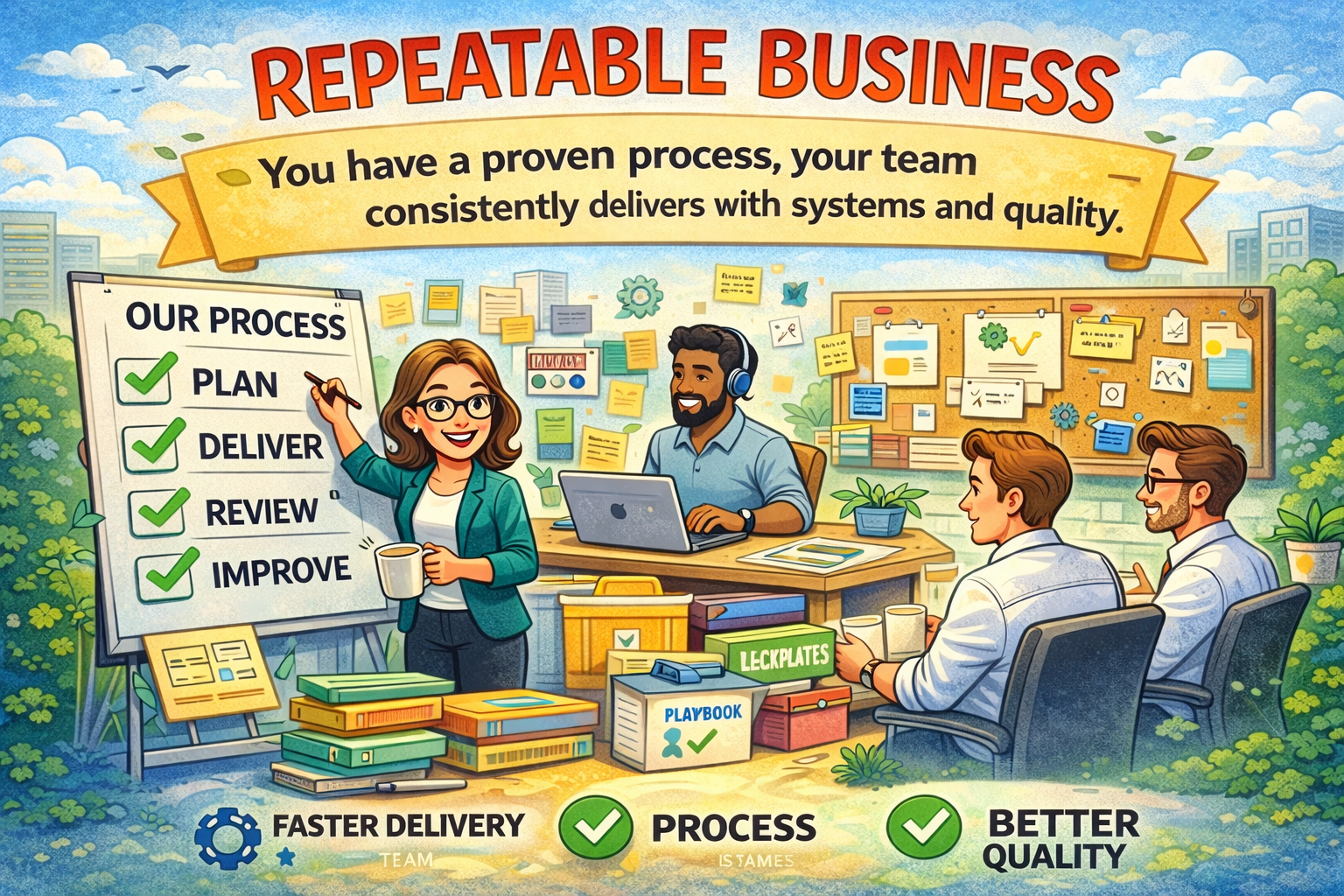
A repeatable business has defined processes.
Delivery happens consistently without relying on memory or improvisation.
The same service can be delivered again and again with predictable quality.
I often summarise this progression as:
First time new
Second time similar
Third time same
In software development this meant reusing code libraries and organising teams into client-facing and delivery roles.
Many service businesses operate successfully at this stage.
Examples include:
marketing agencies
HR consulting
operational consulting
training companies
bookkeeping and financial services
These businesses grow through systems and delegation.
Case Study: Moving From Replicable to Repeatable
One founder I worked with spent enormous amounts of time writing proposals.
Each proposal was written from scratch.
When we examined the situation more closely, the problem became clear.
The delivery process lived entirely inside her head.
Her instinct was to promise clients she would adapt the work completely to their situation:
“Tell me what you want and I’ll build something around it.”
Instead we reversed the approach.
Together we documented the delivery process that worked best for most clients.
The proposal shifted from:
“Tell me what you want.”
to
“This is the process we use because it works.”
The results were immediate.
proposals became faster to produce
the documents looked more professional
clients understood what to expect
expectations were clearer from the beginning
Counter-intuitively, her proposals won more work, not less.
By defining the process she moved her business from replicable expertise toward repeatable delivery.
Scalable Businesses
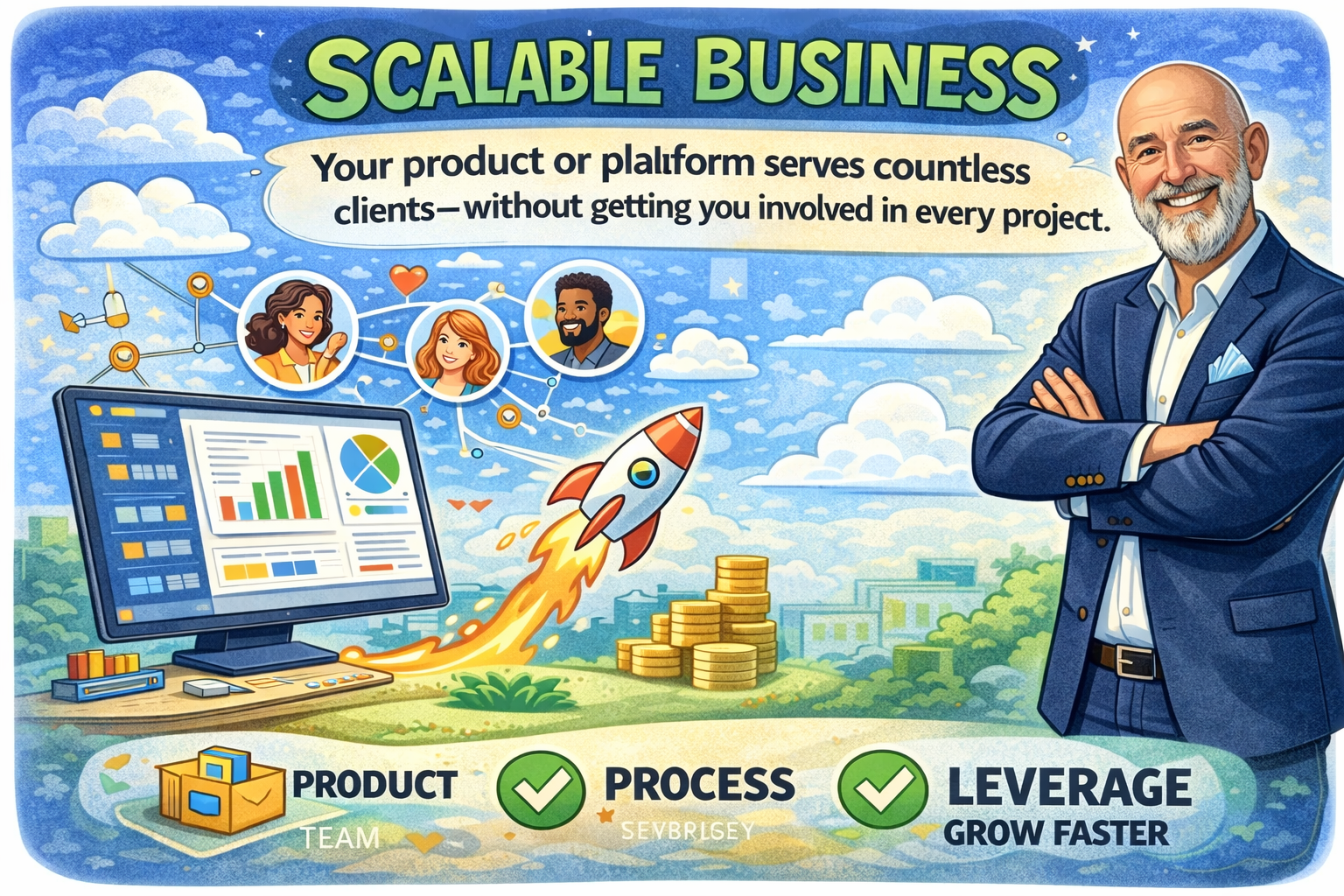
A scalable business grows revenue faster than the cost of delivering the service.
The founder does not need to be present in every project.
Value is delivered through technology, platforms, or intellectual property.
Examples include:
SaaS software
licensing frameworks
digital platforms
subscription products
online learning platforms
These businesses scale because systems replace labour.
Choosing the Right Growth Model
None of these models is inherently better.
Many excellent six-figure businesses are replicable or repeatable, rather than fully scalable.
But confusion between them often causes founders to pursue strategies that do not fit their business.
Business Model Key Feature Typical Goal
Replicable Expertise delivered by specialists High-income expert firm
Repeatable Defined systems and processes Stable operational growth
Scalable Technology or licensing creates leverage Rapid growth or platform model
Understanding which model you actually have is the starting point for designing the next stage.
The Leadership Shift
Growth rarely comes from doing more work.
It comes from doing different work.
The founder who built the business usually started as an operator — solving problems and delivering work.
But the next stage requires a different role.
The founder becomes the designer of the business.
Early Stage => Next Stage
Deliver the work => Design the system
Solve problems => Set standards
Make every decision => Define decision frameworks
Manage tasks => Shape strategy
This shift can feel uncomfortable.
Many founders built their identity around being the person who gets things done.
But without this shift, growth becomes exhausting.
Is Your Revenue Built Around You?
Another important question is whether revenue belongs to the company or to the founder personally.
In many service businesses, the founder’s expertise and relationships generate most of the income.
Clients buy from you because they trust you.
That is valuable - but it can limit growth.
Many founders address this by gradually separating the work:
team members deliver operational tasks
the founder focuses on strategy and expertise
processes document how work is done
client relationships become shared
administrative work is systemised
Eventually the founder begins to think about the company in the third person:
Can the business do this?
Rather than:
Can I do this?
Learning to Trust the Process
Delegation often fails for one reason.
Not because founders lack capable people.
But because they lack trusted systems.
Without clear structures founders constantly check:
reviewing work
monitoring email
worrying something has been missed
That vigilance is exhausting.
When processes are well designed, something different happens.
Responsibilities become clear.
Information becomes visible through simple dashboards.
Standards are understood by everyone involved.
And the founder gains something rare.
Mental space.
That space allows better thinking, clearer decisions, and stronger commercial outcomes.
Designing the Business You Actually Want
Eventually founders reach a deeper question.
Not simply how to grow the business.
But what kind of business they want to own.
Some founders want scale:
a larger organisation
significant growth
a future sale
Others want sustainability:
high income
smaller teams
freedom of time
Both are valid.
But the business must be designed intentionally to support whichever future you choose.
A Quick Founder Diagnostic
Ask yourself three questions:
If I stepped away for a month, could my team deliver the work?
Is the delivery process documented somewhere outside my head?
Could this product be sold without my personal involvement?
Your answers usually reveal whether your business is:
replicable, repeatable, or scalable.
I’ve created a deeper diagnostic tool for exactly this question here.
The Real Work of the Next Stage
The next stage of a business is rarely about working harder.
It is about changing the role you play.
The founder who built the company must become the leader who shapes it.
That means letting go of habits that were once essential:
doing everything
holding every decision
carrying every responsibility
Instead the work becomes designing a structure where the business can function — even when the founder is not involved in every detail.
For many founders, that is where the real freedom of business ownership begins.
A Final Thought
Many founders reach the point where the business works — but feels heavier than it should.
Revenue is coming in.
Clients value the work.
But growth still depends on the founder carrying too much.
Often the real opportunity is not working harder.
It is redesigning the structure of the business.
If you are trying to understand whether your company is replicable, repeatable, or scalable — and what the next stage might look like — that is exactly the type of conversation I have with founders.
You can learn more about my coaching work here: